The text, diagrams, and content of this standard are licensed under a Creative Commons Attribution 4.0 International License.
Trademarks, logos, brand names, and any official branding are not licensed under Creative Commons.
PrivateEZ™ and QRCauseTM are trademarks of High Bit Security, LLC. QRCause is a patent-pending application from High Bit Security, LLC. All references to PrivateEZ™ or QRCause™ are to be considered trademarked, whether so noted or not. All rights reserved. Permission to use any trademark or logo must be obtained separately, in a written Trademark Licensing Agreement.
Trademarks and Brand Names Owned by Others - NOTICE
All other brand names, product names, platform names, and trademarks mentioned in this document (including but not limited to Amazon Alexa, Google Home, Apple HomeKit, Samsung SmartThings, Home Assistant, Nest, Ring, Philips Hue, Ecobee, Mozilla and similar examples) are the property of their respective owners. They are used solely for identification, illustration, and educational purposes to describe common smart home component categories and features. Their inclusion does not imply any endorsement, affiliation, sponsorship, approval, or relationship with this open standard or its authors. No trademark rights are claimed by this document other than those specifically claimed above. All content is an original synthesis and does not reproduce copyrighted material from any source.
Contents
The overall purpose of this document is to create the standards necessary to ensure privacy in smart home deployments. The primary beneficiaries of this standard are Home Residents, Home Builders, Property Management Firms, Realtors, and Employers with remote or hybrid workforces. These are not the only groups, and the list continues to grow. All of these groups share increasing concerns over data leakage from the home, although for different reasons. This document aims to create a working standard and framework, flexible enough to grow as need arises, and that, when followed, will mitigate most or all of the concerns of these and related groups.
When used as intended, this document creates a single, reliable, and trustworthy standard that thoroughly covers all aspects of smart home privacy, which is then paired with a reliable trustmark. The trustmark is integral to the standard, and the two elements together are intended to ensure the home is working for homeowners, not spying on them — intentionally or not.
ContentsPrivacy concerns surrounding smart home technology — particularly AI-powered voice assistants such as Alexa, Google Home, and Siri — have grown significantly in recent years. Homeowners worry about always-listening microphones, unintended recordings, cloud data processing, and potential third-party sharing. At the same time, companies with remote and hybrid workforces increasingly view employee smart-home components as uncontrolled attack surfaces that could leak sensitive business data. These rising concerns highlight the urgent need for a clear, open, and adoptable public standard that defines privacy-protective practices for smart home systems with and without AI voice interactions.
Homeowners show rising adoption paired with growing privacy worries, especially around voice assistants and AI features. Multiple independent surveys document this increase year-over-year (2024–2025 data):
Companies increasingly treat employees’ personal smart home components as enterprise security risks in the era of permanent hybrid/remote work. Key findings include:
In the US, recent 2025–2026 polling shows that both Democrats (and Democratic-leaning independents) and Republicans (and Republican-leaning independents) share high levels of distrust toward government handling of private data and major cloud providers / AI systems that power smart home voice technology. This rare political convergence creates broad, cross-party support for stronger privacy standards.
This evidence — spanning homeowners, employers, and all major political parties and independents — demonstrates a clear, accelerating demand for standardized privacy protections in smart home technology in general, and AI voice technology in particular. That demand spans almost every aspect of our lives, including our homes, our jobs, and our politics.
Anything that concerns homeowners also impacts the entire home owner market, including Realtors, Home Builders, Home Improvement, Property Management firms, the insurance market and other related industries. Those 'other industries' expand to almost everything when Employers with Remote workforces are considered.
It may seem odd that employers and home residents could share the same privacy concerns, but in most cases there is no conflict of interest and a great deal of shared interest. Most employers do not want — and take strong measures to avoid — collecting personal data from employees when it is unrelated to their job. Doing so would put them in jeopardy of a growing body of employer/employee privacy law. Employers worry about the unintentional leakage of data, in both directions: employer proprietary data leaking out, and employee private data leaking in. Both cause problems of different types and both occur through the increasingly broadening attack and leakage surface of smart homes. As the number of remote employees increases every year and the homes they occupy become more and more “leaky,” the problem grows very quickly.
So, Home Residents are concerned, and Employers with remote workforces are concerned. Fortunately, it turns out that most of the concerns of both groups are mitigated by the same expedient: making the home a private sanctuary for life and work. Getting control of the home is the critical first step for peace of mind, whether you are a CISO worried about smart mirrors capturing your employees login screens, or a home resident who wants to ensure that the same smart mirror isn’t sending private images to the cloud.
Taken all together, it seems unlikely that the current market vacuum for the actual service of those concerns will long be tolerated. From work to play, top to bottom and left to right, it may be hard to find a topic more universally demanded than privacy in the home, yet until now there has been no workable standard.
Why?
ContentsDespite nearly universal concern, there is no road map. Instead, a few scattered standards, regulations, policies and frameworks from disparate governments, industries, and watchdog groups provide a patchwork of unverified controls, most of which are unusable or indecipherable to the average consumer. The traditional answer to such mass confusion has been political action. The data shows, however, and common sense suggests, that politics is an unlikely path to a solution.
Political Solutions. The problem has existed for quite some time, with no solution. History suggests that if and when politicians do act — no matter which country, region, or party they represent — the action will be a “compromise” with plenty of exceptions that enable and codify some privacy abuses as much as control them. The studies show that the public distrusts government with this issue as much as they distrust industry, regardless of party. Politicians are viewed as the root of half of the problem, deriving much of their funding from the other half of the problem. That either side could produce a solution without compromising with the other side of the aisle, or molifying their own funding providers with codified exceptions, is something we and the public view as unlikely at best. Any political solution is probably too little, too late and too compromised. The surveys suggest that this is not just our view, but a widely shared view.
Existing Standards. We do need a solution, but we have no wish to re-invent the wheel. One of our initial hopes was that we might find all of the requirements for smart home privacy already addressed in other standards, which we then might simply pull together by reference. To that end we conducted a thorough analysis of existing privacy standards, certifications and frameworks. As they relate to smart homes, we found that they range from nearly completely irrellevant to highly relevant, but they all lacked two major attributes:
So, political solutions are too little, too late and too compromised, if enacted at all. Existing standards are there, but they are all incomplete and lack mechanisms to make them usable to the public and employers.
Any workable solution must cover the entirety of the problem, be trusted, and be useable to the public and to employers with as little effort as possible. Those three concepts: coverage, trust and useability, are the backbone of this standard.
Coverage. This standard develops coverage requirements by analyzing the commonly used smart home components for privacy concerns, and then creating a control list that covers all of those concerns. It turns out to be a remarkably short and simple list, once your really analyze it. This control list is the coverage basis for the standard.
Trust. The public needs to know that the control list is well founded and the enforcement of those controls can be trusted. This standard creates a framework to do that. It builds on the controls by providing 'certification marks', backed by transparent USPTO rules, that anyone can look up on their own. This is crucial and integral to the standard. It will be discussed further in Section 1.
Useability. The control list, no matter how well founded, is no more than a 'wish list' if you can't use it. The biggest single innovation in this standard is the information delivery framework that allows all parties to benefit from the standard with minimal effort. Without this factor, even a thorough and trusted standard would be quite useless to the public or to employers. It is an absolute necessity, and we will cover it Section 1.
Links valid as of date of post, not monitored.
[1]: Copeland Study Reveals Increasing Concerns Around Data Privacy in Smart Home Products (January 2025)
[2]: AHS Smart Home Survey 2024: Adoption, Concerns, and ROI (May 2025)
[3]: CNET Survey Shows 73% of Voice Assistant Users Express Privacy Worries About AI (May 2025)
[4]: NIST Survey on Smart Home Users’ Security and Privacy Perceptions and Actions: component Category Perspective (December 2025)
[5]: Deloitte 2025 Connected Consumer Survey (September 2025)
[6]: Smart Home Growth Increases Enterprise Security Risks (October 2025)
[7]: Why 70% of Companies Fear Their Own Hybrid Employees - Insider Risk Report (October 2025)
[8]: YouGov: Vast majorities of Democrats and Republicans are concerned about technology’s effect on personal privacy (March 2026)
[9]: Pew Research Center: Republicans, Democrats now equally concerned about AI in daily life (November 2025)
[10]: Center for Democracy & Technology (CDT): Common Concern - Americans Worried About Personal Data Held by Public Agencies (March 2026)
[11]: Gallup/SCSP: Americans Prioritize AI Safety and Data Security (September 2025)
[12]: Fox News Poll: Voters see AI as a risk to privacy (April 2026)
[13]: Applicant is not engaged in the production or marketing of the goods or services to which the mark is applied, except to advertise or promote recognition of the certification program or of the goods or services that meet the certification standards of the applicant. (Trust Mark Applications, USPTO, April 2026)
The following definitions apply throughout this Standard:
Why start with delivery? Shouldn’t that be the end of the process?
Yes, but it is also the root of the problem. That was not entirely clear, even to us, when we started this process, but in the end it became the central feature of the standard. There have been many privacy-oriented standards, policies, regulations and other attempts at control over privacy. Most have been helpful, but when it comes to consumers, they all fail for the same reason.
Anyone who has ever waded through dozens of pages of privacy policies, agreements and instruction manuals trying to understand the privacy footing for an interesting product knows for a fact that there is still no good answer.
There is no good answer because no one has asked the most important question. We didn't ask it right away either. When we started this project, we thought the important question was: "what information is necessary to ensure privacy in the home ?". We were wrong. That question, after careful analysis, actually turns out to have a fairly simple answer. The important, and difficult, question is "how do you deliver that information once you have it ?". That, it turns out, is the number one challenge.
To illustrate the problem, we will once again quote from someone other than ourselves: the Mozilla Foundation’s ‘Privacy Not Included’ project. This is an excellent example of good will and substantial effort on the topic of privacy, by an organiztion that is steeped in it. We encourage everyone to have a look at the project, but in this case we are interested in one small section: the comments they make about the effort required to make their ratings:
From https://www.mozillafoundation.org/en/privacynotincluded/about/
Time Spent on Research
We approach our research for Privacy Not Included from the viewpoint of you, the consumer. We don’t purchase the products and test them in a lab. Consumers can’t do that. Instead, we look at all the publicly available information we can find to try and understand the privacy and security concerns you should be aware of. We want to help you understand how long this takes us, in part so you know we’ve taken the time to get things right. But also to help you understand how ridiculous it is that consumers are expected to spend so much time researching connected products before they buy them just to hopefully protect their privacy. It shouldn’t be like this. Companies should do better by building privacy by design into their products.
(bold print is our added emphasis)
We can add one more observation to their comments here, and it couldn't be more important: Many companies do build privacy into their products by design.
In fact, many are trying very hard to be noticed in that regard, it is part of the their marketing plan because they also know that the market is hungry for it. Unfortunately, they face the same problem that consumers face.
The problem is that there is no standard way to deliver the information, so even if companies want to do better and disclose everything, they have no way to easily present it for consumption. They can put it on their website and even try to give as much direction as possible on their packaging and instruction manuals, but you still don’t know if it is complete, where to find it, or how to apply it once you do find it, unless you do the research. Even when a company is trying hard to do it right, and welcomes the opportunity to tell you about it, they all do it differently because there is no standard way to do it. You have to start your research from square one every time.
If an organization as dedicated to privacy as the Mozilla Foundation can’t find the needed information fast enough to make a real-time purchase decision on a product or service, how can we expect any normal consumer to do so? The privacy standards, laws, regulations, policies and procedures we have today are clearly not adequate to the task, and even well-meaning companies can’t fix it alone. In fact, some of the current statutes and regulations, around anti-trust laws in particular, make it nearly impossible for companies to collaborate between themselves to solve the problem even if they want to. They need an independant third party to recognize, organize and facilitate the flow of information.
So, the most important question is: how can the information be organized to present an easy solution for vendors and employers, and allow a consumer to know what they are buying or using before they buy or use it? If this standard fails to answer that question, it will leave the essential problem again unsolved.
That’s why we are starting with information delivery, because it is the heart of the problem. The information delivery solution begins with Trust Marks.
Before we can get to Trust Marks, we need a brief note about structure. This Standard defines the technical privacy and security controls and basics of the information delivery framework. It does not define operational rules or trade mark licensing. These are in separate documents.
The PrivateEZ™ program uses an incremental rating system, visually represented by a designation of one to five stars. The operational rules of the program are defined in the Certification Policy.
The legal right to use the PrivateEZ™ marks and Badges is critical to the success of the Standard, and is governed by the Trademark License Agreement (TMLA). All use of the PrivateEZ™ certification marks and associated QR codes must comply with both the TMLA and the Certification Policy.
High Bit Security produced and maintains this standard and owns the trademarks associated with it. That may not at first seem trustworthy at all, until you know that they are not ordinary trademarks. We have fenced ourselves out of the very market we certify by registering our Trust Marks as USPTO ‘Certification Marks’ (instead of standard ‘Word Marks’). One of the stipulations to registering a Certification Mark in the U.S. is that the owner of the marks may only certify. The owner of the marks cannot produce products or provide services that are also branded with the marks.
That concept, we believe, is critical to public trust and is the first caveat for information delivery: Our Trust Marks may only be used on products or services produced by others and certified by us. They may never be used to represent certification of our own products or services.
Establishing trustworthy marks to indicate privacy compliance is a good first step. However, it is not very useful if it leaves consumers uninformed about what the component or software dependencies are, whether it is compliant by default, or what configuration steps are necessary to achieve the desired privacy. Experience shows that finding that kind of information can take consumers hours or days of research, even if the vendor intends to make it easy.
Vendors have no standardized way to present the information, even when they want to do so. That is where the registry comes in. The registry allows consumers to see all of the required information for any certified Offering, in one standardized location, organized the same way every time.
That is helpful, especially when purposely conducting research, but to use it the consumer still needs to remember or have access to a web address and then look up a product or entity in the registry. That is not always practical and certainly not intuitive.
Ideally, a Trust Mark would automatically expose the registry information required for decision making and correct implementation. Much more than a mark, that kind of intuitive answer could be quite useful to everyone involved, but really helpful to consumers and installers. That is exactly what QRCauseTM (patent pending) is designed to do. QRCauseTM was specifically developed by High Bit Security to create the Badge that supports this standard (https://qrcause.com).
The Badge combines
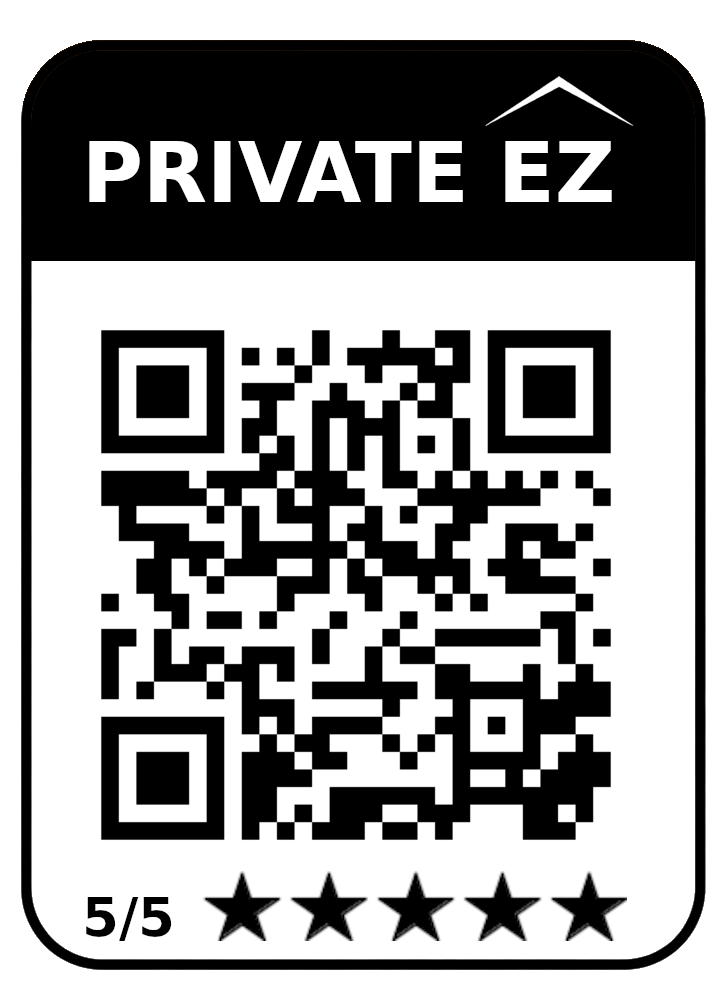
Displayed on packaging and marketing material for certified products and services, this Badge can be available virtually everywhere, including in-store. Here is a working example of a completed Badge pointing to a sample registry page:
Unlike most QR codes, which lead to infinitely varied content provided by those who create them, the code above is integrated into a certification Badge and leads to a standardized registration page that is formatted the same way for every licensee of the same category.
Hopefully it is now clear why we started with information delivery — it is the heart of the framework. There is limited value in knowing that something might be cofigured well. If you can't quickly find out how to do it, then for many practical purposes, it's a waste of time.
Now consumers, installers, realtors and builders can all find the critical information in a fraction of a second using one device: a cell phone or tablet. The remainder of this document will focus on privacy concerns: how we identify and categorize them, how we looked for existing solutions, and how we fully address them.
ContentsThis Standard defines controls for smart home components, human elements, and systems. Collectively, these are called the Control Subjects.
The Control Subjects include:
All certification begins with registration and attestation. An attestation is a formal statement by an entity describing how a specific Control Subject meets the requirements of this Standard. The attestation is reviewed by an the Certification Authority. After successful certification, the attestation information may be made available to the public or kept limited, depending on the certification category and applicable rules.
Registration and attestation alone does not authorize use of the PrivateEZ™ Badge. Use of the Badge is governed by the Certificaton Policy.
This Standard establishes the following categories of certification, each of which is subject to specific rules outlined in the Certification Policy:
WARNING: We are about to 'show our work', demonstrating several steps toward developing a list of privacy concerns and mitigation strategies. It is tedious and you may want to skim, but it is important to document the steps we took to get to our final control list, and this is where we start. If you intend to seek a Knowledge-based certification under this standard, you are advised not to skim.
This section provides a high-level overview of the basic use cases for smart home Offerings and their primary functions.
Smart home Offerings are use-case driven but increasingly defined by integration standards (notably Matter and Thread for seamless cross-brand interoperability), local versus cloud execution models, and the physical or functional domain they serve. Categories frequently overlap; a single Offering may belong to multiple groups.
Functional Grouping
For higher-level analysis, every category in this section can be mapped into one of three primary groups: Devices, Integration and Control Software, and AI Offerings.
This section provides a high-level overview of the primary privacy risks associated with smart home Offerings and recommended mitigation strategies.
Across all categories, the core privacy risks involve data collection, unauthorized access, third-party sharing, inference/profiling attacks, and long-term data retention. The most effective mitigations prioritize local processing, data minimization, strong authentication, regular updates, network segmentation, encryption, and explicit user consent.
Privacy Concerns: Cameras, locks, and sensors constantly collect video, audio, and usage data (often stored in the cloud); smart locks and sensors can reveal occupancy patterns and home/away routines; unauthorized access via weak credentials, unpatched firmware, or breaches; third-party sharing or sale of data; biometric data (facial/fingerprint) is especially sensitive if compromised.
Mitigation Measures:
Privacy Concerns: Thermostats, HVAC systems, and energy monitors reveal detailed occupancy, sleep, and lifestyle patterns; geofencing or motion data can infer location and routines; granular energy usage can be exploited for behavioral profiling or shared with utilities.
Mitigation Measures:
Privacy Concerns: Cloud-connected hubs create single points of failure or broad surveillance; automation logs and activity histories may be stored remotely; voice commands processed through hubs can be recorded.
Mitigation Measures:
Privacy Concerns: Voice assistants and smart speakers may record and transmit conversations; streaming Offerings and smart TVs often use Automatic Content Recognition (ACR) to identify viewed content for profiling or advertising; usage data may be shared with third parties.
Mitigation Measures:
Privacy Concerns: Refrigerators, ovens, and washers track usage patterns (including inventory, cooking habits, and routines); some models include internal cameras; remote access increases risk of unauthorized control or data exfiltration.
Mitigation Measures:
Privacy Concerns: Air purifiers, scales, sleep tech, and sensors collect sensitive health and biometric metrics; data may be shared with third parties, apps, or cloud services (even if not regulated under HIPAA); movement patterns can infer intimate routines.
Mitigation Measures:
Privacy Concerns: Outdoor cameras and sensors capture activity and property boundaries; weather-aware or utility-linked systems may share location/usage data; outdoor Offerings face higher network exposure.
Mitigation Measures:
Privacy Concerns: Always-listening voice assistants can inadvertently (or deliberately) record conversations; voice logs may be retained indefinitely and used for training or profiling; Offerings can be compromised for eavesdropping.
Mitigation Measures:
Privacy Concerns: Smart mirrors, beds/mattresses, biometric locks, and pet tech collect highly personal or intimate data (fitness metrics, sleep patterns, biometric identifiers); third-party integrations may expand data sharing.
Mitigation Measures:
Privacy Concerns: Multi-platform ecosystems can aggregate and correlate data across components and brands; compromise of one account or component can expose the entire system; cross-component tracking is common.
Mitigation Measures:
Privacy Concerns: Smoke/CO detectors and environmental sensors send alerts that can reveal occupancy; integration with other systems may inadvertently expose location or activity data.
Mitigation Measures:
Privacy Concerns: Robotic vacuums create detailed floor plans and maps of the home layout; some include cameras for navigation or monitoring; mapping data may be stored or shared.
Mitigation Measures:
Privacy Concerns: Routers, mesh systems, and network components can expose the entire smart home if poorly secured; telemetry, DNS queries, or unencrypted traffic may leak metadata; network fingerprinting can reveal component types and usage.
Mitigation Measures:
Privacy Concerns: EV chargers, solar inverters, smart meters, and home energy systems generate highly granular usage data that can reveal driving patterns, occupancy, appliance use, and lifestyle habits; data may be shared with utilities or grid operators.
Mitigation Measures:
This section examines existing standards, certifications, and programs that address aspects of smart-home privacy and security. Several of these efforts are excellent within their intended scope. In particular, Home Assistant and the "Works with Home Assistant" program have set a high bar for local control, open interoperability, and reducing unnecessary cloud dependency. PrivateEZ™is designed to complement, not replace, such initiatives. It focuses on a different layer: a standardized, independently verifiable set of privacy and security controls together with a simple, consumer-facing assurance signal that also delivers critical component information. The analysis that follows is intended only to clarify where existing work ends in scope, and where the specific requirements of this Standard require more.
This section outlines the difficulties encountered by both of our primary groups: ordinary home owners and employers, when attempting to mitigate privacy concerns using existing standards. As will be shown, even qualified information security professionals with access to all existing standards and accustomed to reading them, will have a real job just analysing the coverage. It demonstrates the issues by analysis of those other standards and concludes that a new approach is necessary to meet the goals of this standard.
We start by identifying what types of concerns may apply to which types of components. How does a Home Resident even know what kind of information is likely to be exposed with a particular component? How can that resident decide if the exposure is acceptable or not, without even knowing what the potential exposures are? If the resident hires an installer, how does the installer know how to configure a component, or even know if it is configurable, or know if the resident would want it at all, absent a definitive list of potential exposure? Where does an installer or other advisor even start?
The first step then, is to identify the potential concerns. Until you know that, you can’t even start. We have previously identified and categorized smart home components in Section 2, reducing the enormous number of smart components down to a few reasonable categories. We then listed the privacy concerns for each category in Section 4.
Now we can make a further reduction, by organizing the categories and concerns into a usable matrix, which we have done in Table 5.A. This is a critical step in simplification. Without it, there would be little hope of achieving a usable standard at all:
TABLE 5.A - Privacy Implication Matrix for components
| Component Category (from Section 2) | Privacy Implications? (from Section 4) |
|---|---|
| Security & Surveillance | Yes (video/audio, occupancy, biometrics) |
| Climate & Energy Management | Yes (occupancy patterns, usage data) |
| Home Automation & Control | Yes (automation logs, component control) |
| Entertainment & Media | Yes (voice, viewing habits, ACR) |
| Appliances & Kitchen Tech | Yes (usage patterns, inventory) |
| Health & Wellness | Yes (sensitive health/biometric data) |
| Gardening & Outdoor | Yes (location/activity data) |
| Voice & Communication | Yes (voice recordings, conversations) |
| Specialized components | Yes (highly personal data) |
| Home Safety | Yes (occupancy alerts) |
| Smart Cleaning & Maintenance | Yes (floor plans, mapping) |
| Connectivity & Infrastructure | Yes (network metadata) |
| Energy & Grid Integration | Yes (granular usage & lifestyle data) |
That helps somewhat. It makes it easier to align the issues with certain types of components. So, let’s assume that a Home Resident has this information, and can decide which of the concerns are acceptable and which are not. Let’s further assume there are at least some product options to choose from. How would one choose between those options? How does a homeowner know if a specific bathroom mirror addresses the concerns? Assuming it does address the concerns, does it do so by default, out of the box, or does it require specific configuration? If that answer is configuration, does the configuration address the concern in all possible deployment scenarios, or only in some? This is where it might be hoped that there is some standard or formal framework that could make it easy to identify and rank your options.
WARNING: We are about to embark on a high-level exploration of the various existing standards. It is tedious and you may want to skip ahead, but it is important to document the steps we took to get to our final control list, and this is how we did it.
There are many standards/frameworks that are either directly relevant to smart-home privacy & security or are commonly perceived as relevant by vendors, regulators, installers, or consumers.
Do any of them cover what is needed, and how well do they relate to physical components in a smart home? That question calls for another matrix, which we provide in Table 5.B:
TABLE 5.B – Standards and Certifications Overview
| Category | Standard or Framework | Positives | Negatives |
|---|---|---|---|
| IoT components & Ecosystem Standards | Matter Compliance | Provides a solid foundation for security through encryption, authentication, and component attestation. | Privacy protections are limited and depend heavily on the controlling ecosystem. |
| IoT component & Ecosystem Standards | Works with Home Assistant | Excellent at promoting local control, reducing cloud dependency, and enabling open, interoperable, privacy-respecting smart home architectures. | Scope note (not really a "Negatives"): Focuses on local operation and interoperability. It does not define a formal, independently verifiable set of privacy and security controls or a consumer-facing assurance mark beyond the “Works with Home Assistant” designation itself. |
| IoT component & Ecosystem Standards | UL 2900 | Focuses on cybersecurity testing for vulnerabilities and secure development. | Does not directly address data privacy or consent. |
| IoT component & Ecosystem Standards | ETSI EN 303 645 | The leading baseline standard for consumer IoT, with strong provisions for personal data protection, secure updates, and user data deletion. | Compliance is voluntary in most markets. |
| IoT component & Ecosystem Standards | NIST IR 8425 | Defines recommended cybersecurity outcomes for consumer IoT, including privacy considerations. | It is guidance only, not a certification standard. |
| IoT component & Ecosystem Standards | California SB-327 | First U.S. state law specifically for connected components; requires “reasonable security features” and no universal default passwords. | Very high-level with no detailed privacy requirements. California-only. |
| IoT component & Ecosystem Standards | ISO/IEC 27402:2023 | International baseline standard specifically covering both security and privacy for IoT Offerings. | Relatively new (2023); adoption still growing. |
| IoT component & Ecosystem Standards | ISO/IEC 27403:2024 | Specifically tailored to home automation and smart-home systems. | Guidance-focused rather than mandatory certification. |
| IoT component & Ecosystem Standards | ioXt Alliance Certification | Industry-led global IoT security certification program. | Voluntary; focuses more on security than comprehensive privacy controls. |
| IoT component & Ecosystem Standards | OWASP IoT Top 10 | Widely recognized list of the most critical security and privacy risks specific to IoT components. | Not a formal standard or certification — it is a risk-awareness and testing guide only. |
| IoT component & Ecosystem Standards | UK PSTI Regulations | Mandatory UK requirements for consumer connectable products. Strongly aligned with ETSI EN 303 645. | UK-only; focuses mainly on baseline security rather than full privacy-by-design. |
| Organizational / Management System Standards | ISO 27001 | Internationally recognized Information Security Management System (ISMS) standard. | General-purpose organizational standard, not Offering-specific. |
| Organizational / Management System Standards | SOC 2 | Strong focus on security, confidentiality, and privacy controls for service organizations. | Applies only to service providers, not to consumer IoT component vendors. |
| Organizational / Management System Standards | ISO/IEC 27701 | Extension of ISO 27001 specifically for privacy. | Still an organizational standard, not component-level. |
| Legal / Regulatory Frameworks | HIPAA | Provides good privacy protection within medical establishments. | Does not apply to consumer medical or health smart-home components. |
| Legal / Regulatory Frameworks | CCPA/CPRA | Gives California residents strong rights over their personal information. | State law only; applies only to large businesses. |
| Legal / Regulatory Frameworks | GDPR | Comprehensive, extraterritorial privacy law. | Broad legal regulation, not a technical component standard. |
| Legal / Regulatory Frameworks | EU Cyber Resilience Act (CRA) | Upcoming comprehensive EU regulation for cybersecurity of products with digital elements. | Not yet fully in force. |
All of these frameworks/standards have shortcomings for our purposes. Before we do deeper research, it makes sense to ask a very practical question: How would a consumer or installer even know that any component was in compliance with any of these standards?
Many standards are not written with the end user in mind, so let’s see what it takes to actually use any of these standards. We did that in Table 5.C.
TABLE 5.C – Privacy Standards Compliance Verification
| Standard or Framework | Verification Method |
|---|---|
| Matter Compliance | Official Matter logo on the component packaging, label, or retailer/product page. |
| Works with Home Assistant | Official “Works with Home Assistant” badge on packaging, website, or product listings. |
| UL 2900 | UL certification mark on the component or packaging. |
| ETSI EN 303 645 | Vendor’s explicit statement of compliance in the user manual, product datasheet, or website. |
| NIST IR 8425 | No formal certification program. Vendors may voluntarily claim alignment in documentation. |
| California SB-327 | No official logo. Look for a vendor statement of compliance in documentation. |
| ISO/IEC 27402:2023 | Vendors may claim conformance in technical datasheets or security whitepapers. |
| ISO/IEC 27403:2024 | Vendors may reference it in marketing or documentation. |
| ioXt Alliance Certification | ioXt SmartCert logo on packaging or component. |
| OWASP IoT Top 10 | Not a certifiable standard. Vendors may claim they addressed the risks in documentation. |
| UK PSTI Regulations | Required Statement of Compliance (SoC) in the user manual or on the website. |
| ISO 27001 | ISO 27001 certification logo or certificate number on the vendor’s website. |
| SOC 2 | SOC 2 Type 2 report or attestation letter on the vendor’s website. |
| ISO/IEC 27701 | ISO 27701 certification mark (often combined with 27001). |
| HIPAA | Generally does NOT apply to consumer smart-home components. |
| CCPA/CPRA | Check the vendor’s privacy policy for a clear statement of compliance. |
| GDPR | Review the vendor’s privacy policy for explicit GDPR compliance language. |
| EU Cyber Resilience Act (CRA) | CE marking plus an EU Declaration of Conformity. |
It is now quite clear that many of these standards, while excellent for other purposes, are simply too cumbersome to be useful to a consumer. Table 5.D shows what remains when we include only the standards that are component-focused, reasonably verifiable by consumers or installers, and not limited to a single jurisdiction.
Table 5.D
| Standard or Framework | Verification Method |
|---|---|
| Matter Compliance | Official Matter logo on the component packaging, label, or retailer/product page. |
| Works with Home Assistant | Official “Works with Home Assistant” badge on packaging, website, or product listings. |
| UL 2900 | UL certification mark on the component or packaging. |
| ETSI EN 303 645 | Vendor’s explicit statement of compliance in documentation. |
| ISO/IEC 27402:2023 | Vendors may claim conformance in technical datasheets or security whitepapers. |
| ISO/IEC 27403:2024 | Vendors may reference it in marketing or documentation. |
| ioXt Alliance Certification | ioXt SmartCert logo on packaging or component. |
| OWASP IoT Top 10 | Vendors may claim they addressed the risks in documentation. |
It’s a shorter list, but some still require that a user seek out a vendor’s claims. Let’s list only those standards that enforce a true standardized, recognizable notification scheme. In Table 5.E, anything that relies primarily on a vendor’s self-declared statement in non-stadardized locations has been eliminated.
This leaves just four standards — the only ones that give consumers and installers a quick, reliable way to verify compliance without searching for and digging through documentation.
TABLE 5.E – Standards with Enforced Notification Schemes
| Standard or Framework | Verification Method |
|---|---|
| Matter Compliance | Official Matter logo on the component packaging, label, or retailer/product page. |
| Works with Home Assistant | Official “Works with Home Assistant” badge on packaging, website, or product listings. |
| UL 2900 | UL certification mark on the component or packaging. |
| ioXt Alliance Certification | ioXt SmartCert logo on packaging or component. |
This is now a practical shortlist. Time for another matrix. Table 5.F shows coverage of each privacy concern from Table 5.A by these four standards.
TABLE 5.F – Privacy Coverage Matrix
| Component Category | Primary Privacy Concerns | Matter | Home Assistant | UL 2900 | ioXt |
|---|---|---|---|---|---|
| Security & Surveillance | Video/audio, occupancy patterns, biometrics | Partially | Partially | Partially | Partially |
| Climate & Energy Management | Occupancy patterns, usage data | Partially | Fully | Not at all | Partially |
| Home Automation & Control | Automation logs, component control | Partially | Fully | Partially | Partially |
| Entertainment & Media | Voice recordings, viewing habits, ACR | Partially | Fully | Not at all | Partially |
| Appliances & Kitchen Tech | Usage patterns, inventory | Partially | Fully | Partially | Partially |
| Health & Wellness | Sensitive health/biometric data | Partially | Partially | Not at all | Partially |
| Gardening & Outdoor | Location/activity data | Partially | Partially | Partially | Partially |
| Voice & Communication | Voice recordings, conversations | Partially | Fully | Not at all | Partially |
| Specialized components | Highly personal/intimate data | Partially | Partially | Not at all | Partially |
| Home Safety | Occupancy alerts | Partially | Partially | Not at all | Partially |
| Smart Cleaning & Maintenance | Floor plans, mapping data | Partially | Fully | Partially | Partially |
| Connectivity & Infrastructure | Network metadata, component fingerprinting | Partially | Fully | Partially | Partially |
| Energy & Grid Integration | Granular usage & lifestyle data | Partially | Fully | Not at all | Partially |
Home Assistant and the “Works with Home Assistant” program excel at what they were designed to do: enabling local control, reducing unnecessary cloud dependency, and giving users powerful, open tools for privacy-respecting automation. That program is the closest to what we need and the best standard for our purposes.
The last, and real elimination question as it turns out, is this one: How many of the standards that remain allow easy access to configuration information in a standardized location? Answer: 0.
It is now clear that even the standard with the most overlap was designed for different purposes. Further, even all of them together can not fully address our full, envisioned scope. It is not possible to use even a combination of existing standards to arrive at full coverage as we envision it. We have no objection to doing so. When we started, we hoped we might. We now know there is no such combination.
That is why we decided that we will not rely on other standards, as we orginally thought we might. We recognize their value and may even cite them, but they were not written for an entire ecosystem of home owners, employers, component vendors, installers of smart home components and other related professions, auditors and facilities. All of these participants either supply or need access to component information, and there is simply no existing solution to do it.
What we need
Any component intended for smart home use should employ more than just a trust mark that indicates its potential for privacy. Ideally, it should also readily expose the information required for decision making around privacy issues, and for the correct implementation of those decisions.
In other words, it should be easy to know the issues, easy to know what the component can do, and easy to know how to do it. We actually have a good start already: We have listed the privacy concerns in Section 5.
Now, in 5.1, we get some controls around those concerns. These controls are designed to support certification under the incremental rating system defined in the Certification Policy.
Any component that supports remote or account-based administrative access must support two-factor authentication (2FA) and must not allow default or easily guessable passwords.
Components that are configurable only over the local network must require a strong component-specific PIN or equivalent local authentication for initial setup and any subsequent configuration changes.
Components with no administrative interface at all are exempt from this requirement.
The component must support automatic security updates. Automatic updates must be enabled by default.
If automatic updates are not enabled by default, the PrivateEZ™ compliance Manual must include a specific, step-by-step reference showing exactly how the user can enable them.
All firmware and software updates must be cryptographically signed and verified by the component before installation. The component must reject any update that cannot be verified.
Updates must not re-enable any sensor, feature, or data collection capability that the user has previously disabled through physical or software controls, unless the user explicitly re-enables it after the update.
In all cases, the component must also provide clear instructions on how to check for, download, and apply all available security updates.
All core functions — including scheduling, automation, basic operation, and any user-initiated commands — must continue to work fully even when the component has no internet connection and the vendor’s cloud service is completely unavailable.
Occasional or optional use of the cloud is permitted only when explicitly enabled by the user.
The component may collect or transmit only data that is strictly necessary for its documented primary functions (as stated in the product’s marketing materials and in the PrivateEZ™ compliance Manual).
The vendor must include in the PrivateEZ™ compliance Manual a complete data inventory table that lists every type of data the component collects, stores, or transmits. For each data element the table must state: - the specific primary function it supports, and - a clear justification of why that data element is necessary for that function.
All sensors, cameras, microphones, telemetry, analytics, diagnostic, or any other data-collection features that are not required for the component’s documented primary functions must be disabled by default. Any optional or secondary data collection requires explicit user opt-in before it can be enabled.
Voice Command and Wake Word Logging
Any component that uses voice commands or a wake word must clearly disclose in the PrivateEZ™ compliance Manual whether audio is captured or retained before the wake word is detected. If pre-wake-word audio is captured or retained, the manual must describe what is captured, how long it is retained, and how the user can disable this behavior.
Default Data Retention
The component must define and apply reasonable default data retention periods. Data must not be retained longer than necessary for the component’s documented primary function unless the user has explicitly opted in to longer retention. The PrivateEZ™ compliance Manual must state the default retention period for each category of data collected.
Any sharing of data — including data listed in the data inventory table in the PrivateEZ™ compliance Manual — with third parties, cloud services, or any external entity requires explicit, granular user opt-in before it can occur.
The PrivateEZ™ compliance Manual must clearly describe, for each data element in the inventory table: - whether and with whom that data may be shared, - the exact purpose of the sharing, and - the step-by-step process (with page or section reference) by which the user can review, grant, or revoke permission for that sharing at any time.
All data sharing must be disabled by default until the user explicitly enables it.
Any component that captures audio, video, static images, voice-prints, or any biometric or behavioral data (including but not limited to gait, heart rate patterns, sleep patterns, or other inferred behavioral profiles), or environmental/biochemical data (including olfactory/scent data, volatile organic compounds (VOCs), chemical signatures, or any other air, water, or environmental sampling) must either:
Any component that captures audio, video, static images, voice-prints, biometric or behavioral data, or environmental/biochemical data (including olfactory/scent data, volatile organic compounds (VOCs), chemical signatures, or any other air, water, or environmental sampling) must either:
All data transmitted by the component must be encrypted in transit using current industry-standard cryptographic methods.
Any user data or configuration data stored on the component must be encrypted at rest using industry-standard methods where technically feasible. If at-rest encryption is not implemented for any data element listed in the data inventory table, the PrivateEZ™ compliance Manual must include a specific reference (page number, section number, or step number) that discloses this limitation and describes the component’s storage practices and any compensating controls in place.
The component must support a complete, one-step factory reset that permanently deletes all user data, credentials, network settings, and configuration.
The PrivateEZ™ compliance Manual must include a specific reference (page number, section number, or step number) that provides clear, step-by-step instructions for performing the factory reset and any recommended post-reset verification steps to confirm that all personal data has been removed.
The entity must complete this checklist for every component submitted for PrivateEZ™certification (Offering). For each control, enter one of the following in the Default Compliance column: Yes, No, or Partial.
If the answer is No or Partial, the entity must provide a precise reference in the PrivateEZ™ compliance Manual column (page number, section number, or step number) showing exactly where the user or installer can find the relevant instructions or compensating controls.
| Control | Requirement (Summary) | Default Compliance | Reference in PrivateEZ™ compliance Manual (required if No or Partial) | Entity Notes |
|---|---|---|---|---|
| 5.1.1 | Strong Authentication | |||
| 5.1.2 | Current Firmware (automatic updates + integrity + no re-enablement of disabled features) | |||
| 5.1.3 | Local-First Operation | |||
| 5.1.4 | Data Minimization (complete data inventory + retention periods + wake word logging controls) | |||
| 5.1.5 | User-Controlled Data Sharing | |||
| 5.1.6 | Physical and Environmental Privacy Controls (including voice-prints and biometric/behavioral data) | |||
| 5.1.7 | Clear Activity Indicators | |||
| 5.1.8 | Encryption of Data | |||
| 5.1.9 | Secure Decommissioning |
The PrivateEZ™Checklist must be presented using the exact template above (or the corresponding database entries) to ensure that installers and consumers receive all expected information in a consistent format.
The checklist and manual ensure that every privacy concern is considered and every related exception or special approach is addressed in a standard format.
The last step is standardizing the location of the regisration data, by linking directly from the Badge on the packaging and promotional material. The Badge and QR code are integral components of the standard and described elsewhere. The specific certification requirements associated with each rating level are defined in the Certification Policy and the use of the Badge itself is governed by the Trademark License Agreeement.
Audit controls for components are described in the Certification Policy.
This section provides a high-level overview of the primary privacy risks associated with smart home related facilities and recommended mitigation strategies.
Across all facility categories, the core privacy risks involve data collection and retention, unauthorized access or interception, third-party sharing, inference/profiling attacks, and long-term data remanence. The most effective mitigations prioritize data minimization, encryption in transit and at rest, strict access controls, local/on-premise processing where possible, and explicit contractual prohibitions on secondary use. Where feasible, privacy decisions should favor facilities that support end-to-end encryption, zero-knowledge architectures, or verifiable deletion policies.
Privacy Concerns: ISPs and telco infrastructure can inspect traffic metadata or perform deep packet inspection, revealing occupancy patterns, component types, and behavioral routines; CDNs log IP-based update requests that create indirect usage fingerprints.
Mitigation Measures:
Privacy Concerns: Cloud providers and data centers store the majority of user-generated smart home data; edge nodes and on-premises servers may still sync sensitive streams; any external processing creates a copy of private data outside the home.
Mitigation Measures:
Privacy Concerns: Smart-grid operators and municipal systems receive granular energy and status data that reveals detailed home occupancy and routines; bidirectional grid communication expands the attack surface.
Mitigation Measures:
Privacy Concerns: Minimal direct impact once components are deployed, but insecure firmware or pre-loaded telemetry code can create persistent privacy risks after installation.
Mitigation Measures:
Privacy Concerns: Negligible direct risk to deployed homes; these facilities operate pre-market.
Mitigation Measures:
Privacy Concerns: SOCs and identity services receive real-time logs and alerts from homes; key management services hold credentials that could expose entire households if breached.
Mitigation Measures:
Privacy Concerns: Third-party AI/analytics providers and field technicians have direct or indirect access to raw home data; emergency routing can inadvertently disclose occupancy.
Mitigation Measures:
Privacy Concerns: Improper data wiping before disposal can leave personal data (videos, logs, credentials) recoverable.
Mitigation Measures:
This section defines the core privacy controls for facilities, including the Facility Privacy Controls Checklist and the internal Facility Auditor Checklist.
Facilities present different challenges from components. Facilities are not directly observable by Home Residents, and unlike products that may be privacy-focused, facilities are often general-purpose or have conflicting commercial influences.
These are good reasons to treat facilities differently, but we retain our basic approach: certification begins with an attestation from facilities that want to be registered and certified. What differs is the control list and supporting documentation, which is necessarily different but still aligns with the incremental rating system defined in the Certification Policy.
The following controls apply to facilities.
Facilities may collect, process, store, or transmit only data that is strictly necessary for the documented primary functions supporting smart home components.
The facility must include in the PrivateEZ™ compliance Manual a complete data inventory table that lists every category of smart-home-derived data the facility collects, stores, or processes. For each data element the table must state the specific primary function it supports and a clear justification of why that data element is necessary.
All secondary collection, analytics, profiling, or telemetry features not required for the primary function must be disabled by default.
All data transmitted to or from the facility must be encrypted in transit using current industry-standard cryptographic methods.
Any smart-home-derived data stored by the facility must be encrypted at rest using industry-standard methods. If at-rest encryption is not implemented for any data element, the PrivateEZ™ compliance Manual must disclose this limitation and describe any compensating controls.
Any administrative, diagnostic, or data-access interface must require multi-factor authentication and must not allow default or easily guessable credentials. Access must follow the principle of least privilege and must be logged with immutable audit trails.
Facilities must minimize logging of smart-home-derived data to only what is strictly necessary for service delivery, security, or regulatory compliance. Logs must not create behavioral profiles or occupancy fingerprints beyond the documented primary function.
All non-essential logging must be disabled by default.
Any processing, sharing, or transfer of smart-home-derived data with third parties, sub-processors, or external entities requires explicit, granular opt-in from the facility customer before it can occur. All such processing or sharing must be disabled by default.
The facility must support complete, verifiable deletion of all smart-home-derived data upon request or at the end of the service relationship (including backups and replicas). Retention must be limited to the shortest period necessary for the primary function.
Where technically feasible, the facility should offer or support local/on-premise processing, end-to-end encryption, or zero-knowledge architectures. If such options are not available, the PrivateEZ™ compliance Manual must disclose the limitation and describe compensating controls.
All contracts and data-processing agreements must explicitly prohibit secondary use, sale, behavioral profiling, or any use of smart-home-derived data beyond the documented primary function.
Facilities must conduct regular privacy impact assessments focused on smart-home data flows and must make summary results available to customers. Facilities must also support independent audits of their controls upon reasonable request.
Every facility submitted for PrivateEZ™certification must complete this checklist. For each control, enter Yes, No, or Partial in the Default Compliance column.
| Control | Requirement (Summary) | Default Compliance | Reference in Uploaded Support Manual | Facility Notes |
|---|---|---|---|---|
| 7.1.1 | Data Minimization | |||
| 7.1.2 | Encryption of Data | |||
| 7.1.3 | Strong Access Controls | |||
| 7.1.4 | Minimal and Transparent Logging | |||
| 7.1.5 | User-Controlled Data Processing and Sharing | |||
| 7.1.6 | Verifiable Data Deletion and Retention Limits | |||
| 7.1.7 | Support for Local-First or Zero-Knowledge Architectures | |||
| 7.1.8 | Contractual Purpose Limitation and No Secondary Use | |||
| 7.1.9 | Privacy Impact Assessments and Audit Transparency |
Facility Provider: Nexus Cloud, LLC
Facility/Service: Nexus SmartHome Cloud Platform
PrivateEZ™Registration Number: 9876543
Control Requirement (Summary) Default Compliance Reference in Uploaded Support Manual Facility Notes 7.1.1 Data Minimization Yes ✅ — Full inventory table provided 7.1.2 Encryption of Data Yes ✅ — TLS 1.3 + AES-256 7.1.3 Strong Access Controls Yes ✅ — MFA + least privilege enforced 7.1.4 Minimal and Transparent Logging Partial ⚠️ Nexus Operational Logging Policy, Page 14 Behavioral logging disabled by default 7.1.5 User-Controlled Data Processing and Sharing Yes ✅ — Granular opt-in required 7.1.6 Verifiable Data Deletion and Retention Limits Yes ✅ — 90-day max retention; verifiable deletion supported 7.1.7 Support for Local-First or Zero-Knowledge Architectures Partial ⚠️ Nexus Architecture Guide, Page 22 Zero-knowledge option available via customer-managed keys 7.1.8 Contractual Purpose Limitation and No Secondary Use Yes ✅ — Explicit prohibition in DPA 7.1.9 Privacy Impact Assessments and Audit Transparency Yes ✅ — Annual PIA + SOC 2 Type II available
Unlike components, Home Residents normally have no direct visibility into their data once it leaves the home and enters a facility. This makes independent auditing especially important.
Facility audits are more complex than component audits. To keep costs manageable while maintaining rigor, facilities are required to provide detailed evidence references for every control as part of the internal auditor checklist. This checklist and use is defined in the Certification Policy.
It may seem counterintuitive to certify a home — which requires collecting data about that home — when the entire focus of this standard is privacy in the home. However, there are valid use cases for doing so, including:
We begin with real estate transactions, as the discussion of component inventory provides the foundation needed for both real estate and employer use cases.
In the U.S., smart home components are classified as either real property (fixtures) or personal property (chattel) in real estate transactions. This classification is based on longstanding common-law principles, with some variation by state.
Courts generally apply a three-part test to determine whether an item is a fixture:
Smart home technology creates many gray areas, as even hardwired devices can be disputed depending on removal damage and account linkage.
The contract controls everything. Sellers and buyers should explicitly list which smart home components stay with the home, which are excluded, and confirm that all associated accounts, apps, passwords, and hubs will be transferred at closing.
A Home Inventory Attestation creates a verifiable list of installed smart home components and classifies them as fixtures or chattels. This supports clean transfer during real estate transactions or changes in occupancy. Homes receive a certification rating as defined in the Certification Policy.
A Full Home Certification confirms that the home as a whole meets the privacy controls defined in this Standard and receives a certification rating as defined in the Certification Policy.
Smart home components installed by tenants generally remain the tenant’s personal property (chattel) unless they become permanent fixtures. Tenants are typically allowed to remove their installations at the end of the tenancy, provided removal causes no permanent damage to the property.
Many employers require assurance that remote employees are taking reasonable steps to protect privacy and proprietary information. Employers should have a way to mitigate those concerns, without receiving excessive personal details about the home.
This standard addresses that need through a PrivateEZ™ WorkZone™ report, which provides basic, high-level assurances. The audit and resulting WorkZone™ report is performed either directly by the Certification Authority or by a PrivateEZ™ Certified Professional (WorkZone™ Auditor). The WorkZone™ report is simple, and does not include the component inventory or any detailed configuration information. Special rules for handling and distributing PrivateEZ™ WorkZone™ reports are defined in the Certification Policy.
The PrivateEZ™ WorkZone™ Report contains:
A PrivateEZ™ WorkZone™ audit shall not evaluate every smart-home component for full PrivateEZ™ compliance. The audit is limited to those components and systems that represent a realistic risk of compromise to the employer’s security posture (audio or visual capture of work-related activity, network pivot potential, or data-exfiltration paths).
The PrivateEZ™ WorkZone™ audit shall use the following prioritized risk-factor inventory to determine scope.
The following categories shall be excluded from a PrivateEZ™ WorkZone™ audit unless the device is physically located in the primary workspace and contains an unexpected camera or microphone:
The Audit for PrivateEZ™ WorkZone™ shall take the following steps:
The PrivateEZ™ WorkZone™ audit may optionally include Employee Awareness Training (EAT). When EAT is performed it shall be provided by the same WorkZone™ Auditor who performs the audit, at the time of the audit. The training will consist of an in person training, question and answer session and will cover the entirety of this section 8.5 with those in attendence. The WorkZone™ Auditor will be prepared to attest that the entire section 8.5 was covered, and collect the full names of those in attendence.
The process is designed so that Home Residents do not need authenticated access to the system. All authenticated activity is reserved for entities that have executed a Trademark Licensing Agreement (TMLA). The process is defined in the Certification Policy.
PrivateEZ™ Home Component Inventory
Home Address: 123 Privacy Lane, Anytown, USA 12345
Registration Date: 15 June 2026
Home Resident / Attestor: Jane Doe
PrivateEZ™Registration Number: HOME-478291
Certification Status: Inventory Attestation
Component Category Make / Model Location Wired / Wireless Fixture / Chattel Notes Security Camera SecureCam Pro SCP-400 Front Door Wired Fixture Hardwired fixture Smart Thermostat EcoTherm Elite Living Room Wired to HVAC Fixture Permanently installed Smart Locks Keyless Entry XL All exterior doors Battery + wired deadbolt Chattel Removable Voice Assistant Echo Hub Kitchen Wireless Chattel Portable
PrivateEZ™ WorkZone™ Report
Home Address: 123 Privacy Lane, Anytown, USA 12345
Auditor Firm: JT Enterprises
Auditor Full Name: Jill Turner, Certified Auditor #94Z0-63AD-340S
Audit Date: 20 June 2026
Standard: PrivateEZ™Privacy and Security Standard v1.3
Result: PASS – All applicable controls verified compliant
Employee Awareness Training Verified Attendance:
Jane Doe
John DoeAuditor’s PrivateEZ™ Certification Mark (or Certification Authority Brand Mark):

ContentsPrivateEZ™ Full Home Certification Report
Home Address: 123 Privacy Lane, Anytown, USA 12345
PrivateEZ™Registration Number: 94Z0-63AD-340S
Certification Date: 20 June 2026
Certification Valid Until: 20 June 2027
Auditor: Jill Turner, JT Enterprises
Certification Summary
All installed smart home components meet or exceed the controls defined in this Standard. The home operates with local-first operation enabled wherever technically feasible.Auditor’s PrivateEZ™ Certification Mark (or Certification Authority Brand Mark):
We have now covered all of the Control Subjects previously introduced, except for Knowledge-Based certifications. There have been several cases in this standard that call for the use of certified professionals.
Knowledge-based certifications are intended to create a readily available pool of qualified professionals who understand this standard and can apply it in their respective fields.
The underlying and common requirement for all Knowledge-based certifications is knowledge of this standard, together with knowledge of a specific related field. All requirements are defined in the Certification Policy.
We began this standard with observations of concern over smart home privacy from two primary groups: Home Residents and employers with remote workforces.
We demonstrated, with reference to multiple independent studies and surveys, that these concerns are real, growing, and span the entire political spectrum.
We suggested that political solutions are unlikely to be the most effective path forward, and that while existing standards and initiatives are valuable, they do not fully address the core requirements outlined in this document — particularly the need for timely, actionable information at the point of decision.
Instead, we developed a practical approach centered on standardized information delivery through a trust mark and QR code system, combined with clear, auditable controls. This standard introduces an incremental certification rating system (visually represented as 1 to 5 stars on the Badge) that applies across components, facilities, and homes, supported by Knowledge-Based certifications for the professionals who install, audit, and manage these systems.
Together with the Trademark Licensing Agreement and the associated certification processes, this framework represents our contribution to improving smart home privacy while enabling practical use cases in real estate transactions and remote work environments.
We began with a clear problem: the rapid proliferation of smart home technology, especially in conjuction with AI, has outpaced our ability to understand and control the privacy implications. This standard offers one coherent response — a framework built on transparent information delivery, measurable controls, and professional accountability. It is our contribution toward a future in which technology serves the home, rather than the home serving technology.